
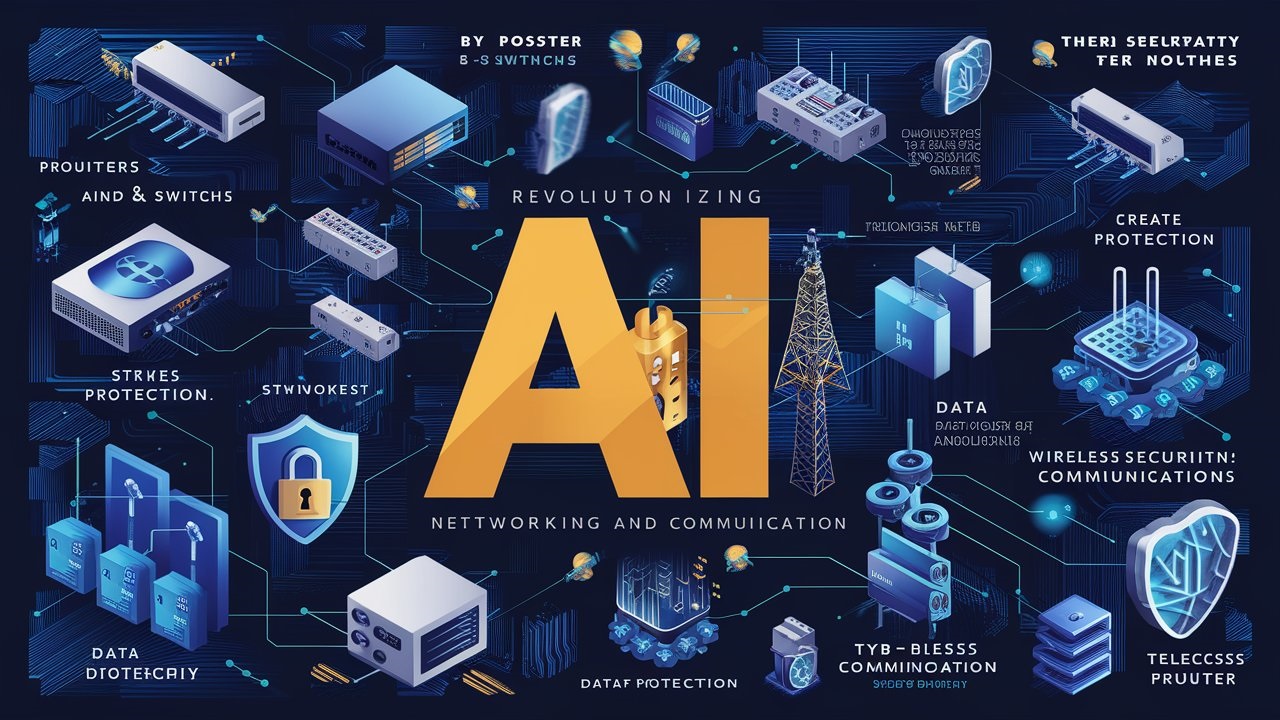
Why AI Is Changing the Network
For years, enterprise networks were primarily designed around users accessing applications, files, cloud services, and the internet.
AI workloads are different.
Training and running modern AI systems can involve large volumes of data moving continuously between servers, GPUs, storage systems, and cloud platforms. This creates new requirements for bandwidth, latency, packet loss, congestion management, and network reliability. Gartner notes that enterprise WANs and network services are evolving to support AI traffic patterns and performance requirements. Gartner
AI Traffic Is More Demanding
Traditional office traffic is often bursty and relatively forgiving. AI workloads can be far more intensive.
Large AI jobs may require many GPUs to operate together as one distributed computing system. If the network becomes slow or congested, expensive compute resources can sit idle waiting for data.
NVIDIA describes AI training traffic as highly sensitive to tail latency, congestion, and GPU-to-GPU communication performance, which is why purpose-built AI fabrics are becoming more important. NVIDIA Perspectives
Higher Bandwidth Is Becoming Essential
As AI infrastructure grows, organizations are moving toward higher-performance networking.
Gartner reports that AI workload requirements are pushing enterprises and hyperscalers toward high-bandwidth switches, while broader enterprise networking demand is shifting toward high-speed Ethernet and more scalable infrastructure. Gartner
For businesses, this may mean upgrading from older 1GbE environments toward:
2.5GbE and 5GbE for modern office and access networks
10GbE and 25GbE for servers, storage, and higher-performance enterprise workloads
100GbE and beyond inside large data centers and AI infrastructure
The exact requirement depends on workload size, architecture, and future growth.
Latency Matters as Much as Speed
AI networking is not only about raw bandwidth.
Low and predictable latency is also important because distributed AI workloads require many systems to communicate continuously.
Even if a network is theoretically fast, congestion, packet loss, or inconsistent latency can reduce overall AI performance.
That is why AI-focused networking emphasizes:
Low latency
Lossless or highly reliable data delivery
Congestion management
Consistent throughput
Fast server-to-server communication
NVIDIA says modern AI fabrics are designed around deterministic latency and lossless throughput to keep accelerators fully utilized. NVIDIA
East-West Traffic Is Growing
Traditional enterprise networks often focus heavily on north-south traffic—users communicating with servers, cloud services, or the internet.
AI creates much more east-west traffic, meaning data moves between:
GPU ↔ GPU
Server ↔ Server
Server ↔ Storage
AI Cluster ↔ AI Cluster
This changes how data-center networks must be designed.
The network is no longer simply a connection between systems. In high-performance AI environments, it becomes part of the computing platform itself.
Ethernet Is Evolving for AI
Ethernet remains extremely important because organizations already understand and operate it at scale.
However, standard best-effort Ethernet may not always be ideal for large distributed AI workloads.
This has led to AI-optimized Ethernet technologies designed to improve congestion control, latency, and scalability.
NVIDIA’s Spectrum-X platform, for example, combines AI-focused Ethernet switching and specialized network adapters to support large-scale AI environments. NVIDIA
At the largest scales, organizations may also use InfiniBand or other specialized interconnect technologies depending on workload requirements. Gartner identifies Ethernet, InfiniBand, and other high-performance interconnect technologies among the key networking trends supporting GenAI infrastructure. Gartner
Enterprise Networks Are Becoming AI-Ready
Not every business needs a massive AI data center.
But even organizations using AI through cloud services, private AI platforms, local inference, or AI-enabled applications may see network demand increase.
A more AI-ready enterprise network may include:
- Higher-speed switches
- Faster server uplinks
- Wi-Fi 7 for modern access environments
- Better segmentation and security
- More resilient core networks
- High-performance storage connectivity
- Improved monitoring and traffic visibility
Gartner says AI-enabled workloads are already influencing demand for high-performance data-center switches, Wi-Fi 7, and scalable network infrastructure. Gartner
Why Businesses Should Plan Ahead
AI adoption is accelerating rapidly.
Gartner forecasts worldwide AI spending to reach approximately $2.7 trillion in 2026, with AI infrastructure—including servers, network fabrics, semiconductors, and cloud infrastructure—representing one of the largest areas of investment. Gartner
This means businesses planning new infrastructure today should consider not only current requirements, but also future AI workloads.
A network designed only for today's office applications may become a bottleneck when the organization begins adopting:
Private AI models
AI-powered analytics
Computer vision
Intelligent automation
Agentic AI systems
AI-enabled cloud platforms
The Network Is Becoming Part of the AI Platform
AI is changing the role of networking.
In the past, the network mainly connected users to applications.
In the AI era, the network increasingly connects compute, storage, data, and intelligence.
That means the future enterprise network must be:
Faster. More reliable. Lower latency. More scalable. More secure.
Businesses that modernize their network infrastructure early will be better prepared for the growing demands of AI-driven applications and digital transformation.
Revolution Technology BD provides enterprise networking, servers, storage, cybersecurity, structured connectivity, and IT infrastructure solutions for organizations preparing for the next generation of business technology.