
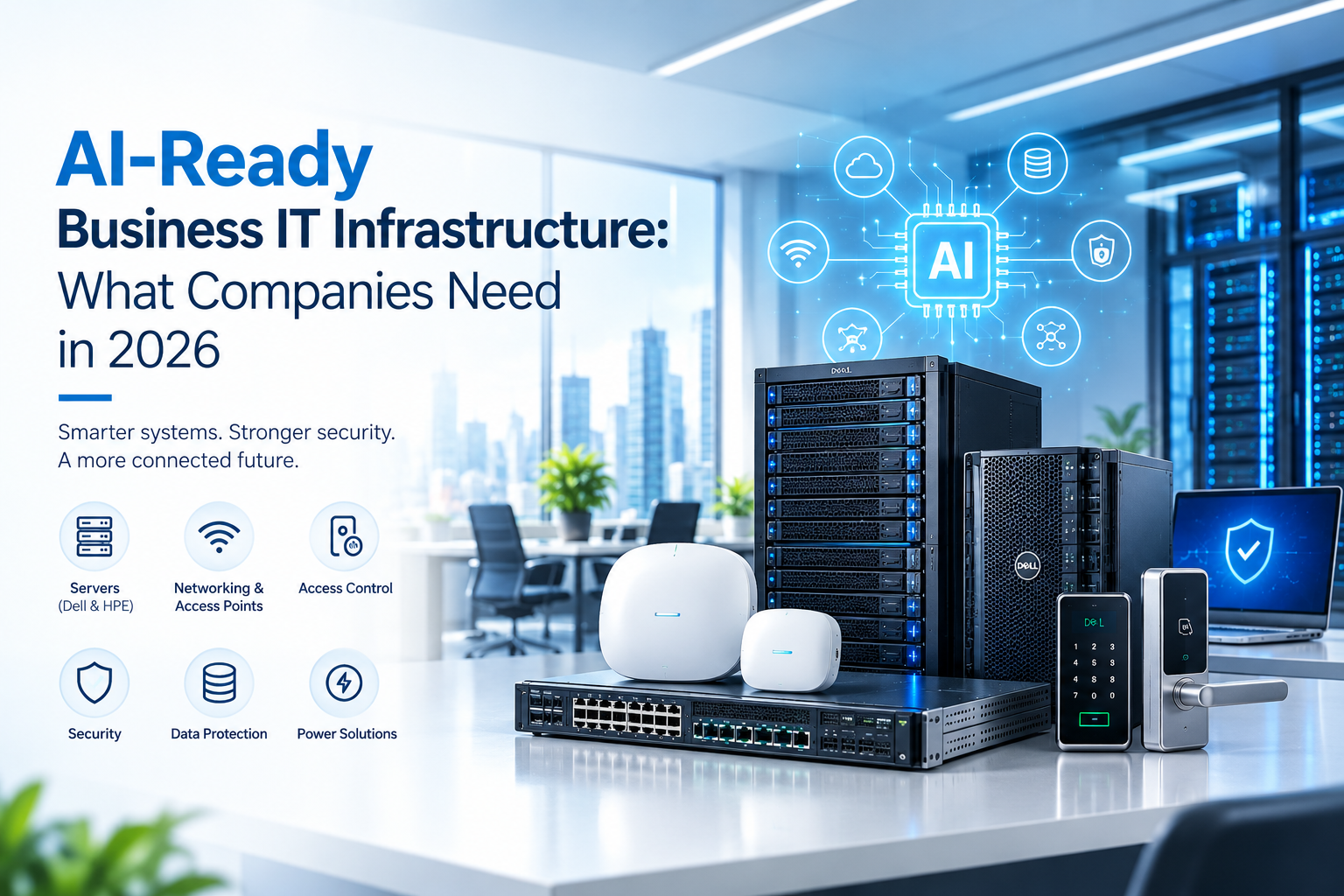
AI-Ready Business IT Infrastructure: What Companies Need in 2026
Artificial intelligence is rapidly becoming part of everyday business operations. From AI-powered productivity tools and customer support to data analysis, automation and intelligent decision-making, companies are finding new ways to use AI to improve how they work.
But adopting AI is not simply about subscribing to an AI platform or purchasing an AI-enabled laptop.
The real foundation of successful AI adoption is a reliable, secure and scalable IT infrastructure.
In 2026, businesses need to think beyond individual devices and build an IT environment that can support growing computing demands, high-speed connectivity, data security, physical security and business continuity.
For organizations planning an IT upgrade, here are the key components of an AI-ready business IT infrastructure in 2026.
1. Powerful and Scalable Servers
AI applications and modern business workloads are becoming increasingly data-intensive. Even when companies use cloud-based AI services, they still depend on reliable infrastructure for data management, applications, virtualization, databases, file services and internal business systems.
For organizations running critical workloads on-premises, choosing the right server is therefore an important infrastructure decision.
Modern business servers can provide:
High-performance processors for demanding workloads
Large and expandable memory capacity
Enterprise-grade storage
RAID support for data availability
Redundant power supplies
Remote server management
Scalable expansion options
Enterprise-level reliability
Businesses may also need different server configurations depending on their requirements. A small organization may need a compact tower server, while a growing enterprise may require a rack-mounted server with higher memory, storage and processing capacity.
Revolution Technology BD provides server solutions from established enterprise brands, including Dell and HPE, with configurations ranging from entry-level business servers to more powerful multi-processor systems.
The key is not simply choosing the most powerful server available. Businesses should select a configuration based on their current workloads, expected growth, application requirements and future expansion plans.
2. A High-Performance Business Network
AI applications depend on connectivity.
As businesses increasingly use cloud platforms, SaaS applications, AI assistants, video conferencing, cloud storage and data-intensive applications, network performance becomes an important part of overall productivity.
A slow or poorly designed network can create bottlenecks even when the company's computers and servers are powerful enough.
A modern business network should consider:
High-performance access points
Reliable routers and switches
Sufficient network capacity
Coverage across the workplace
Support for high device density
Network security
Scalability for future devices
Enterprise wireless networks also have to support far more than laptops. A modern office can have smartphones, IP cameras, printers, smart displays, IoT devices, access-control systems and other connected equipment operating simultaneously.
This makes business-grade wireless infrastructure increasingly important.
Revolution Technology BD offers business networking and access-point solutions designed for organizations that need reliable wireless connectivity across offices and commercial environments.
3. Secure Access to Business Systems
As more applications, devices and services become connected, controlling who can access what becomes increasingly important.
An AI-ready infrastructure should not only be fast. It should also be secure.
Businesses should consider multiple layers of protection, including:
User authentication
Endpoint security
Network security
Access control
Data protection
Permission management
Monitoring and logging
Physical access is also an important part of the overall security strategy.
For example, businesses may need to control access to offices, server rooms, restricted areas or other sensitive facilities. Modern access-control systems can help organizations manage authorized entry and improve visibility over physical access.
Revolution Technology BD provides access-control solutions for businesses and organizations looking to strengthen their physical security infrastructure.
4. Protect the Data Behind Your AI
AI is only as useful as the data available to it.
Business data can include customer records, financial information, employee information, documents, sales data, operational records and proprietary company knowledge.
As companies integrate AI into their workflows, protecting this information becomes increasingly important.
Businesses should therefore consider:
Data Storage → Access Control → Security → Backup → Recovery
Simply storing data is not enough.
Organizations should also have appropriate backup and recovery strategies so that important information can be restored following hardware failure, accidental deletion, cyber incidents or other disruptions.
A strong AI strategy therefore needs to include data protection alongside computing infrastructure.
5. Power and Infrastructure Reliability
A powerful server is of little value if an unexpected power interruption shuts it down.
Servers, networking equipment, security systems and other critical IT infrastructure require stable and reliable power.
Businesses should consider appropriate power protection such as:
UPS systems
Backup power
Surge protection
Redundant power supplies
Battery backup for critical infrastructure
Power monitoring
For organizations increasingly dependent on digital systems, infrastructure resilience should be considered part of IT planning rather than an optional addition.
6. Build for Scalability
One of the biggest mistakes businesses can make when upgrading IT infrastructure is planning only for today's requirements.
Technology requirements can change quickly.
A company that currently has 50 employees may have 100 or 200 employees within a few years. The number of connected devices may grow even faster.
AI adoption can also increase demand for:
Computing resources
Storage
Network bandwidth
Security controls
Data processing
User access
Backup capacity
This is why businesses should evaluate scalability when purchasing servers, networking equipment and other infrastructure.
Expandable memory, additional storage capacity, flexible networking and modular infrastructure can make future upgrades easier.
7. Physical Security and Digital Security Should Work Together
Business security is no longer only about protecting computers from malware.
Companies need to consider both digital security and physical security.
For example, a business may have excellent cybersecurity controls but still face risk if unauthorized individuals can physically access a server room or restricted office.
An integrated infrastructure strategy can therefore combine:
Cybersecurity + Network Security + Physical Access Control + Data Protection
This layered approach can help businesses reduce security gaps across their technology environment.
8. AI Infrastructure Is About More Than AI
The term "AI-ready infrastructure" can sometimes make businesses think they need expensive AI servers or specialized hardware immediately.
That is not necessarily the case.
For many organizations, becoming AI-ready starts with strengthening the fundamentals:
Computing
Reliable desktops, laptops and servers capable of supporting modern applications.
Connectivity
Fast, stable and scalable wired and wireless networking.
Security
Protection for endpoints, networks, identities and data.
Storage
Sufficient capacity for growing business data.
Backup
Reliable recovery mechanisms for critical information.
Physical Security
Controlled access to offices, server rooms and sensitive areas.
Power
Reliable power protection for critical equipment.
Once these foundations are in place, businesses can introduce more advanced AI workloads as their requirements evolve.
What Should Businesses Consider Before an IT Upgrade?
Before investing in new infrastructure, organizations should ask:
1. What AI and digital applications are we planning to use?
Identify the actual business workloads instead of purchasing technology simply because it is marketed as "AI-ready."
2. Where will our data be stored and processed?
Determine whether workloads will run on-premises, in the cloud or through a hybrid model.
3. Can our existing network handle future traffic?
Evaluate wireless coverage, device density, bandwidth and network security.
4. Is our infrastructure scalable?
Consider future employees, devices, applications, storage and computing requirements.
5. What happens if a critical system fails?
Review backup, recovery, power protection and business continuity.
6. Who can access our systems and physical facilities?
Evaluate both digital permissions and physical access controls.
The Future of Business IT Is Connected
AI is changing how companies think about technology, but AI is only one part of a much larger transformation.
The businesses preparing for the next stage of digital growth will need infrastructure that connects computing, networking, security, data and physical infrastructure into a reliable technology ecosystem.
A powerful server without a reliable network can create bottlenecks.
A fast network without proper security creates unnecessary risk.
Secure systems without backup can still leave a business vulnerable to data loss.
And advanced technology without reliable power can become unavailable when it is needed most.
The goal of an AI-ready IT infrastructure is therefore not simply to have more powerful technology. It is to build an environment that is reliable, secure, scalable and ready for what comes next.
Build Your Business IT Infrastructure with Revolution Technology BD
Revolution Technology BD provides technology products and IT solutions for businesses, organizations and institutions.
From enterprise servers and business networking to access points and access-control solutions, we help organizations find technology suited to their operational requirements.
Whether you are planning a new office, upgrading an existing infrastructure, expanding your server environment or preparing your organization for increased AI adoption, choosing the right foundation is an important first step.
Contact Revolution Technology BD for product recommendations, corporate requirements, quotations and IT infrastructure solutions.