
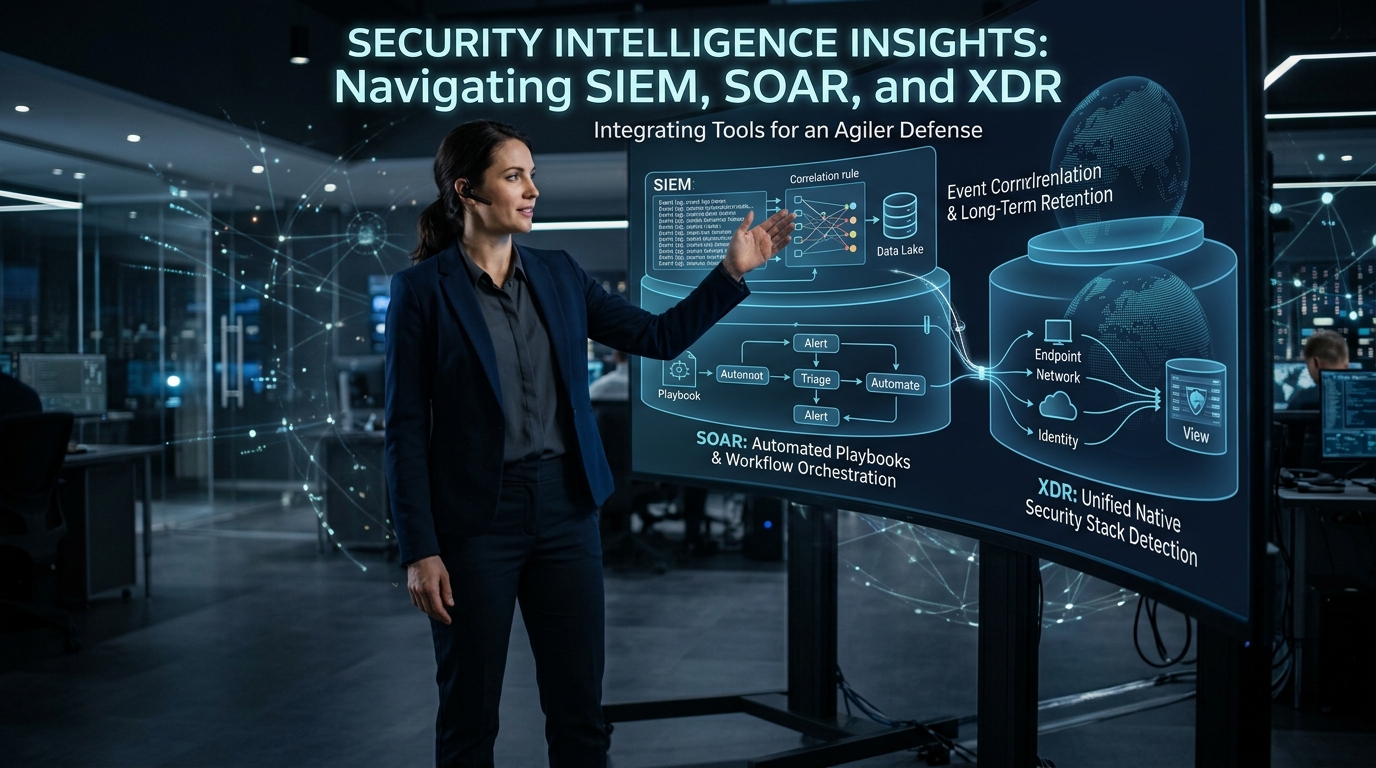
In today's threat landscape, "we have a firewall and antivirus" is no longer a security strategy — it's a starting point.
As cyberattacks grow more automated and harder to detect, organizations are realizing that visibility and response speed matter just as much as prevention. This is where SIEM, SOAR, and XDR come in — three technologies that are frequently confused, yet serve distinct purposes in a modern security operation.
WHY THIS MATTERS NOW
Modern IT environments generate an overwhelming volume of security data — firewall logs, server events, endpoint alerts, cloud activity, and email traffic. Without a system to correlate and act on this data, real threats get lost in the noise.
Meanwhile, regulatory frameworks (including Bangladesh Bank's ICT Security Guideline for financial institutions) increasingly require organizations to maintain centralized log monitoring, audit trails, and incident response capability — making these technologies not just useful, but often mandatory.
UNDERSTANDING THE THREE LAYERS
01 — SIEM (Security Information & Event Management)
What it does: Collects and correlates log data from across the entire IT environment — firewalls, servers, endpoints, applications — into one centralized platform.
Core strength: Detection and visibility. SIEM answers the question "What is happening across my network right now?"
Limitation: A SIEM does not take action on its own. It generates alerts, but a human analyst must investigate and respond — which becomes difficult at scale, often leading to alert fatigue from hundreds of daily notifications.
Best suited for: Organizations with compliance and audit requirements, or those needing a single source of truth for security events.
02 — SOAR (Security Orchestration, Automation & Response)
What it does: Sits on top of a SIEM (or other detection tools) and automates the response process using predefined playbooks.
Core strength: Speed. If a SIEM detects a brute-force login attempt, a SOAR platform can automatically block the source IP, disable the affected account, or notify the security team — within seconds, without waiting for manual action.
Core metric it improves: MTTR (Mean Time to Respond) — reducing response time from hours to seconds.
Best suited for: Security teams that are understaffed relative to alert volume, or organizations wanting to standardize incident response procedures.
03 — XDR (Extended Detection & Response)
What it does: Unifies telemetry from endpoints, network, email, and cloud into a single platform with native correlation — going beyond what traditional SIEM log collection provides.
Core strength: Context. XDR doesn't just show isolated alerts; it reconstructs the full attack chain — for example, tracing a threat from a phishing email → endpoint compromise → lateral movement across the network — as one connected timeline.
Best suited for: Mid-size organizations that need strong detection and response capability but don't have the resources to run a full-scale Security Operations Center (SOC).
HOW THEY COMPARE
| Feature | SIEM | SOAR | XDR |
|---|---|---|---|
| Primary Function | Log correlation & detection | Automated response | Cross-layer detection & response |
| Human Effort Required | High (manual triage) | Low (automated playbooks) | Medium |
| Response Speed | Slow (analyst-dependent) | Fast (automated) | Fast (contextual) |
| Data Sources | Broad (any log source) | Depends on integration | Endpoint, network, email, cloud (native) |
| Best For | Compliance & audit trail | Fast incident response | Unified visibility without a large SOC |
| Typical Adopter | Banks, large enterprises | Existing SOC teams | Mid-size businesses |
Important reality check: These technologies are not mutually exclusive. Many mature security programs run SIEM + SOAR together, while organizations without a large SOC team often find XDR delivers the best balance of detection depth and manageable complexity.
🇧🇩 THE OPPORTUNITY FOR BANGLADESH
Bangladesh's financial, telecom, and enterprise sectors are under growing regulatory and operational pressure to strengthen cybersecurity monitoring:
BANKING & FINANCIAL INSTITUTIONS
Bangladesh Bank's ICT Security Guideline requires centralized log management and incident monitoring — a direct SIEM use case.
MID-SIZE ENTERPRISES
Organizations without the budget for a 24/7 SOC team can achieve strong detection and response coverage through Managed XDR services — without hiring a large internal security staff.
GROWING BUSINESSES WITH LIMITED SECURITY TEAMS
SOAR-driven automation allows a small IT team to respond to threats at a speed that would normally require a much larger staff.
WHAT SHOULD ORGANIZATIONS CONSIDER BEFORE CHOOSING?
Selecting the right platform isn't just about vendor reputation — it depends on your organization's actual security maturity.
Current Visibility Do you already have centralized logging, or are logs scattered across separate systems?
Team Size & Capacity Can your team manually triage alerts, or is automation necessary to keep up?
Compliance Requirements Does your industry require audit trails and log retention (e.g., banking, telecom)?
Existing Infrastructure What firewall, endpoint, and cloud tools do you already run — and do they integrate natively with XDR, or require a SIEM to unify them?
Implementation & Support Deployment, tuning, playbook development, and ongoing management all require expertise — not just software.
A properly matched solution should align with your organization's actual threat exposure, team capacity, and compliance obligations — not simply the most feature-rich product available.
THE FUTURE IS UNIFIED SECURITY OPERATIONS
The direction of the industry is clear: standalone tools are giving way to unified, automated security platforms that combine detection, correlation, and response in one place.
Whether an organization starts with SIEM for visibility, SOAR for automation, or XDR for unified detection, the goal remains the same — reducing the time between when an attack happens and when it's stopped.
READY TO STRENGTHEN YOUR SECURITY VISIBILITY?
A firewall tells you what's blocked.
An EDR tells you what happened on one device.
A SIEM, SOAR, or XDR platform tells you what's happening across your entire organization — and helps you act on it.
DETECT. RESPOND. STAY AHEAD.
Revolution Technology BD
Technology for Today. Solutions for Tomorrow.
Our Solution Implementation team can assess your current infrastructure and recommend the right SIEM, SOAR, or XDR approach for your organization's size, budget, and compliance needs.
KEY TAKEAWAY
SIEM, SOAR, and XDR aren't competing technologies — they're different layers of the same goal: seeing threats clearly and responding to them fast. The right choice depends on your team's size, your compliance obligations, and how much of the response process you need automated.